
By Ken Smith
Driven by the amazingly high cost of housing and the growing unaffordability of car ownership, and the growing unaffordability of car ownership, we’re more motivated than ever to support more communities where people have the freedom to live without a car. That urgency kept us moving, making March another busy and productive month for the Housing Onward team.
Wisconsin State Capitol Visit
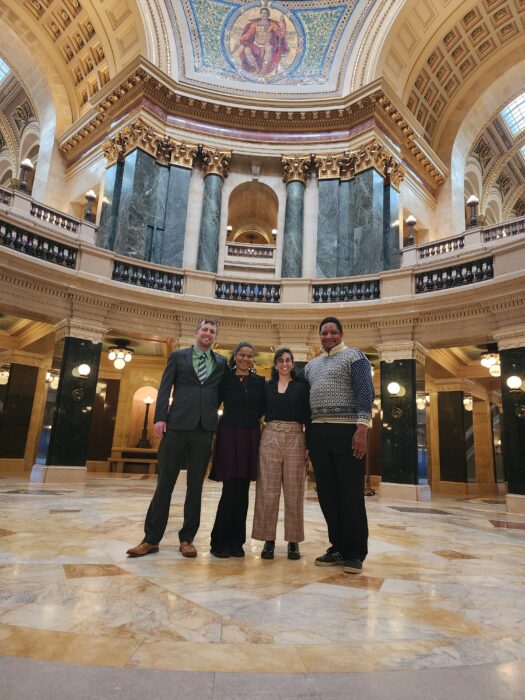
On March 17, Tehila and I rendezvoused at the statehouse with Jarrett English of Dream.Org and Solana Patterson-Ramos of the Together for Homes Coalition (a 1000 Friends of Wisconsin campaign). We chatted with legislative staff and observed some of the final housing-related bills of the legislative session get passed by the Wisconsin Senate.
Note: A recap of the 2025-2026 Legislative Session is coming soon!
Learning About Sustainable Housing in La Crosse
Later, on March 25-26, I traveled to La Crosse for this year’s WI CAN conference. WI CAN stands for Wisconsin Climate Action Navigators, which is an initiative of the Wisconsin Department of Administration’s Office of Sustainability and Clean Energy. At the conference, which was held at La Crosse’s Nature Place, Habitat for Humanity of the Greater La Crosse Region (Habitat LAX) graciously showed us how to ReNew the Block as they beautified the Logan Middle School property with rain gardens and installations for education outside the classroom. Habitat LAX also commissioned a mural on the school, installed bioswales in the terrace of the Avon Street right-of-way, and repaired or improved existing properties neighboring the middle school, revitalizing the neighborhood. At the conference, attendees and panelists also discussed efforts to build sustainable and resilient homes in the La Crosse region.
Municipalities can support organizations like Habitat LAX by making sites available for construction and adopting sufficiently permissive zoning that allows for Habitat for Humanity’s home models where land is available. While volunteer labor, donated materials, and public and private subsidies help reduce costs, land acquisition can be a major barrier to keeping homes affordable for working families who might otherwise be priced out of homeownership.
 Enjoyed the Amtrak from Milwaukee to La Crosse.
- Great Sustainable Housing Conversations with Habitat for Humanity La Crosse
- Community Mural by Habitat for Humanity La Crosse
- Tour of Logan Middle School property with rain gardens.
- Outdoor Education Classroom
- Observing a new Bioswale in the Avon Street right-of-way. It reduces runoff into the nearby Black River.
- Viewing Improvements to Neighborhood Housing
- Attendees and Panelists Discussed How to Build Sustainable and Resilient Homes in the Region
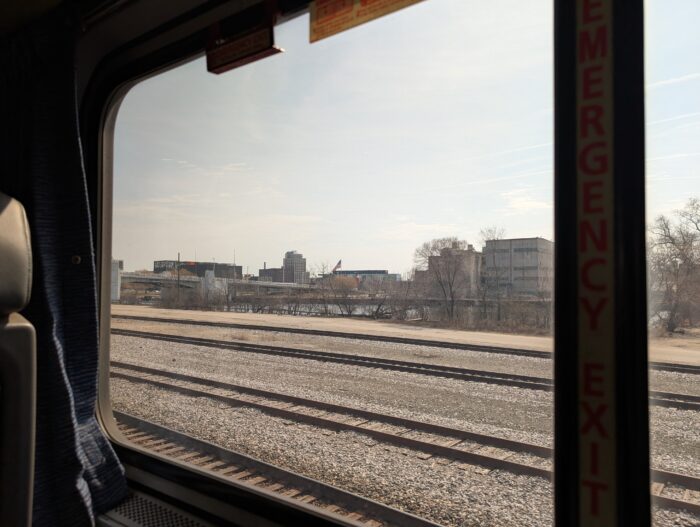
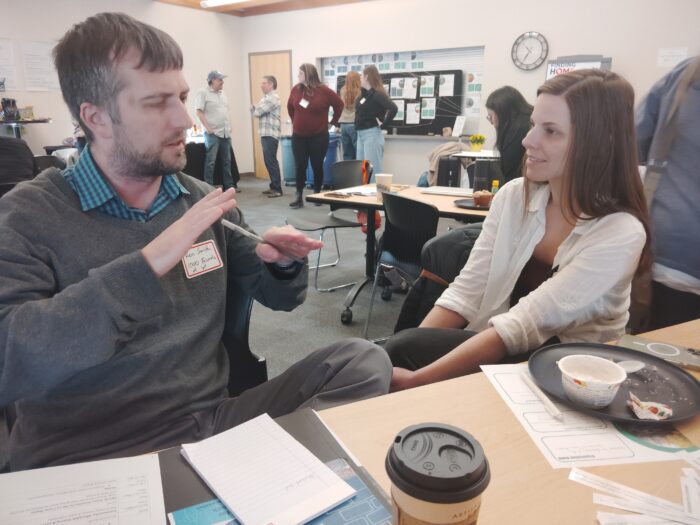

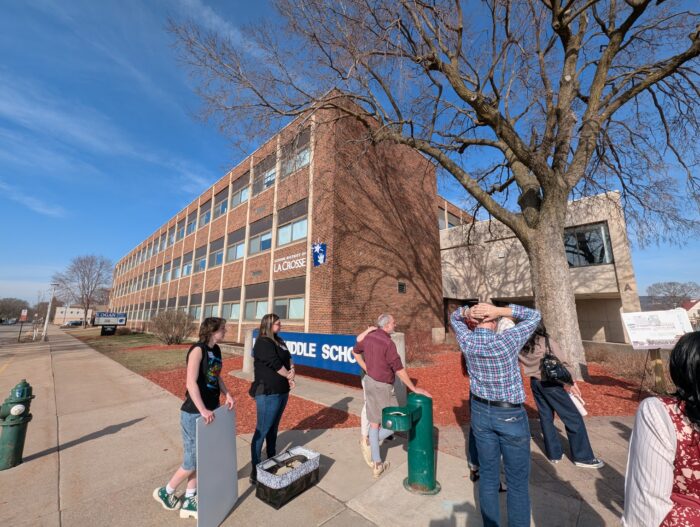
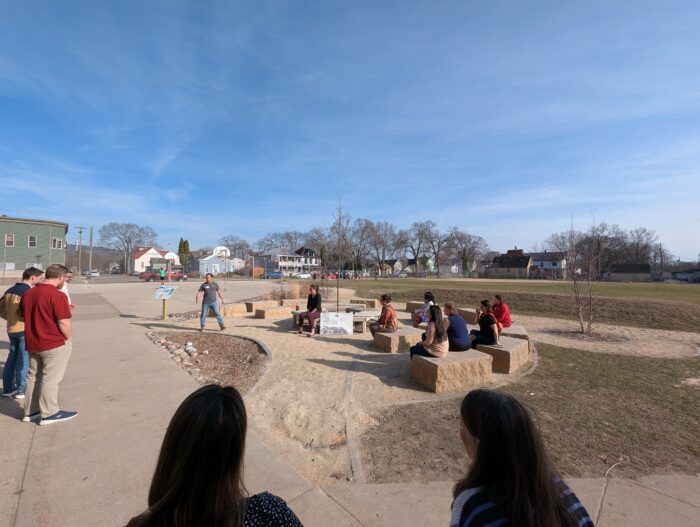
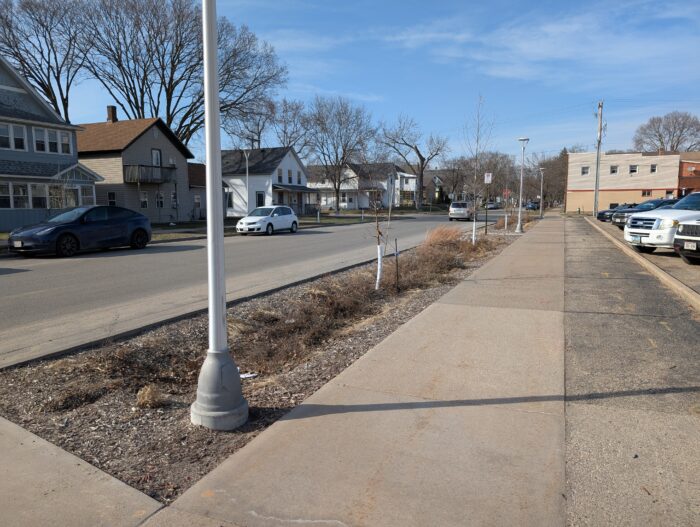
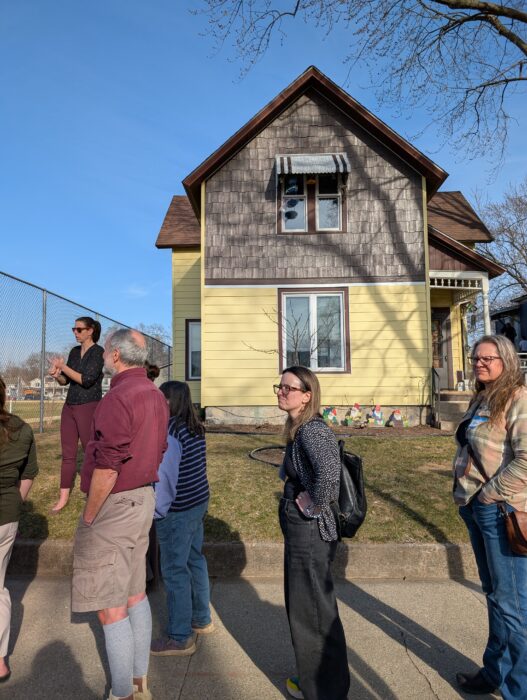
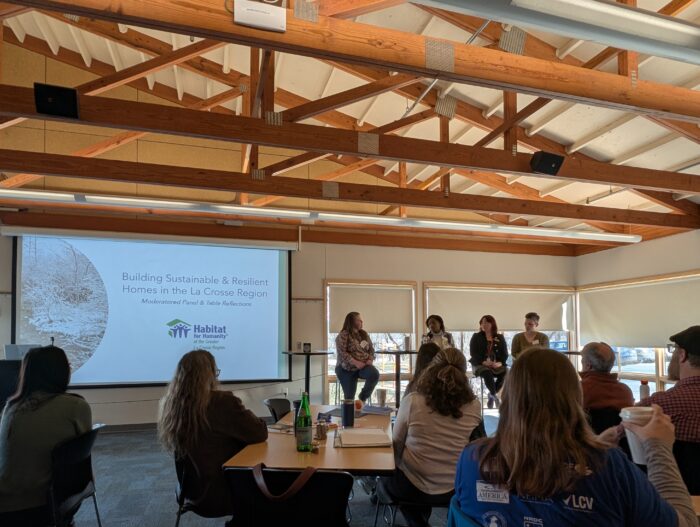
Scenes from the WI CAN Conference in La Crosse, Wisconsin
Profiting from Poverty
In his revealing 2016 book, Evicted: Poverty and Profit in the American City, Princeton sociologist Matthew Desmond (who earned his PhD at UW-Madison) shares stories from eight Milwaukee families as they struggle against the constant threat of losing their homes, revealing how poverty can become a source of profit for corrupt landlords.
As one landlord remarked in the book, “the ‘hood is good.”
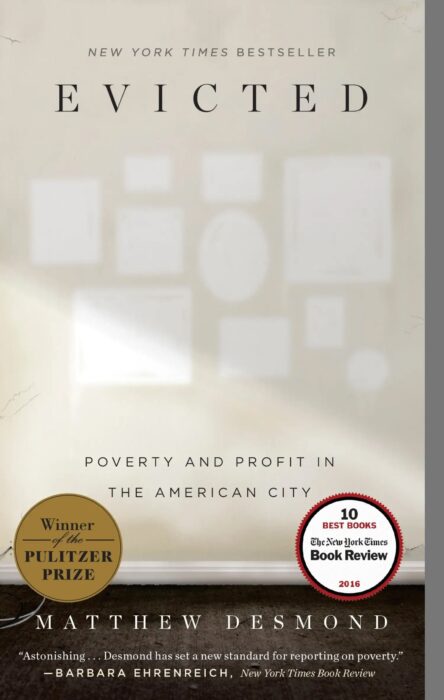
The book, among other things, analyzes some of the specific practices of these profit-maximizing landlords, who unethically treat their tenants and/or provide substandard or even unsafe housing conditions for those who have nowhere else to go. These landlords prioritize profits over everything, spending as little as possible on maintaining properties and/or evading their societal dues by paying just enough property tax to avoid tax foreclosure. The resulting blighted homes hurt the neighborhood and city, making the area less pleasant to live in and negatively affecting the surrounding property values.
1000 Friends of Wisconsin Board Director John Johnson recently chronicled the Rise of Milwaukee’s Billionaire Landlord, Youssef “Joe” Berrada, who owns an estimated 6.4% of rental units in the City of Milwaukee, more than 10,000 housing units with assets worth more than one billion dollars. Berrada settled with the Wisconsin Department of Justice in 2024 for $1.7 million relating to violations of Wisconsin’s landlord-tenant statutes.
Meanwhile, based on information and advocacy from nonprofits Common Ground and Tenants United, the City of Milwaukee City Attorney has initiated litigation against another wealthy landlord, David Tomblin of Highgrove Holdings LLC, who resides outside of Wisconsin. Tomblin allegedly has unpaid property taxes on more than 200 properties and an extensive track record of neglected properties cited for municipal code violations.
To be clear, not all landlords are bad. I’ve worked with many ethical small-scale and corporate landlords. For many small landlords, rental properties serve as both a source of income and a way to build wealth, while also providing homes for people who can’t (or choose not to) take on the costs and responsibilities of ownership. Furthermore, those who live in the same community as their properties often have a shared stake in a place’s prosperity. At the same time, challenging tenant situations do exist—property damage, missed rent, and neighborhood disruptions can place real financial strain on smaller landlords. In the end, whether large or small, landlords are navigating a larger system that often makes it challenging to align financial sustainability with the goal of maintaining quality, affordable housing.
To be clear, not all landlords are bad. I’ve rented from both ethical small-scale and corporate landlords. For many small landlords, rental properties serve as both a source of income and a way to build wealth, while also providing homes for people who can’t, or choose not to, take on the costs and responsibilities of ownership. Furthermore, those who live in the same community as their properties often have a shared stake in a place’s prosperity. At the same time, challenging tenant situations do exist—property damage, unpaid or missed rent, and neighborhood disruptions can place real financial strain on landlords. In the end, whether large or small, landlords are navigating a larger system where they must balance financial sustainability with maintaining quality housing for their tenants.
The Power of Zoning to Facilitate (or Negate) More Housing
As I mentioned last month (and will likely keep mentioning), 2026 marks 100 years of the landmark U.S. Supreme Court case, Euclid v. Ambler Realty Co., in which the Court deemed zoning as constitutional. Last month’s article that I shared discussing zoning was rather mixed, but this piece, “How Zoning Won – and Why It’s Now Losing Ground” details that while municipalities’ use of zoning has helped create the current housing crisis (among other social problems), municipalities can also harness their zoning power to facilitate housing production and undo the problems of past abuse.
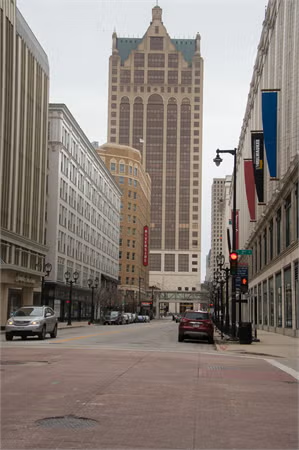
For example, Strong Towns argues that in at least one case: It Just Takes One Letter to Legalize Townhomes. This helped create more housing diversity in Longmont, Colorado – beyond solely single-family detached homes or apartment complexes. A greater diversity of housing types addresses different household needs at various price points.
Another way communities can use zoning to incentivize more housing is, as Pew notes, converting former or underutilized office space into housing. In Milwaukee, developers have been doing this for many years. The Milwaukee BizTimes reports that in 2023, Milwaukee had the second-most apartment units converted from office space in the nation. Unused or underutilized spaces in smaller Wisconsin communities can also be used to address the housing shortage, if zoning allows it.
Fair Housing Month
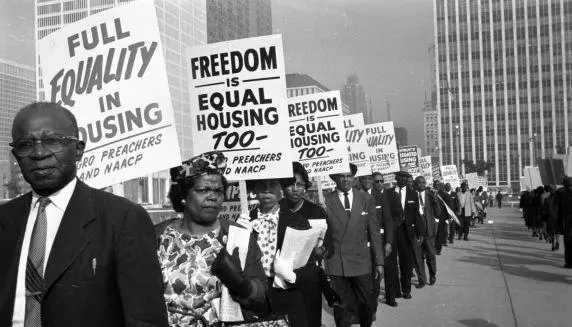
Scott Turner, United States Secretary of the Department of Housing and Urban Development, commemorated the April 11, 1968, signing of the Fair Housing Act by declaring April as Fair Housing Month. The Fair Housing Act prohibits discrimination in the sale, rental, and financing of housing based on race, color, national origin, religion, sex, familial status, or disability.
Dane County marks Fair Housing Month through introspection on its history of racially restrictive covenants through its Prejudice in Places initiative, akin to the Mapping Racism effort sponsored by the University of Wisconsin – Milwaukee. To learn more about the history of the Fair Housing Movement in Wisconsin, a detailed history book on the subject in Wisconsin is Patrick Jones’ Selma of the North: Civil Rights Insurgency in Milwaukee.

The Strongest Town
Speaking of Strong Towns, that organization dedicated to fiscal solvency and community-driven problem-solving paralleled March Madness with its Strongest Town competition. The Strongest Town Contest celebrates progress, not perfection. A “strong town” is any town, big or small, that is taking tangible steps to overcome its transportation, housing, or financial challenges.
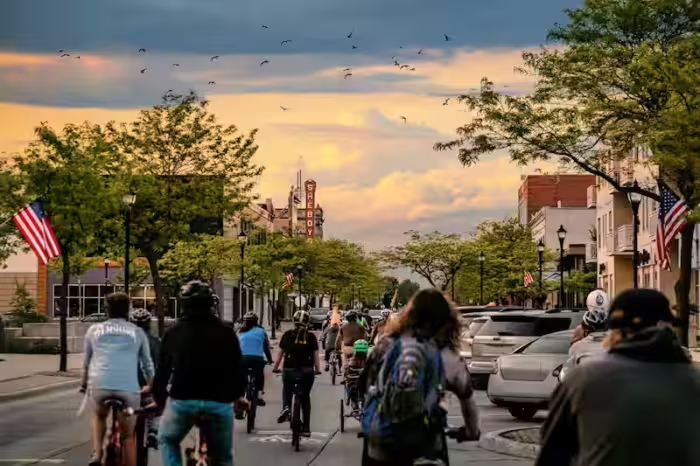
In case you missed it, three vibrant Wisconsin places – the cities of Madison, Sheboygan, and West Allis – were all voted as semi-finalists. Madison defeated Sheboygan to advance to the finals, while West Allis toppled Chicago. Ultimately, it was West Allis that earned this year’s Strongest Town Award.
As part of being crowned the “2026 Strongest Town,” West Allis receives a trophy, a mini-documentary produced about the community, a screening of the documentary, a visit from Chuck Marohn (civil engineer, land-use planner, and founder/president of Strongest Towns), tickets to the Strongest Town National Gathering, and Strongest Town swag items. Congratulations West Allis!

Do you want to be part of future conversations on housing? Let’s connect! Interested in the topic of state-level preemption and statewide policy reform? Subscribe to our emails.