Looking Back Over 30 Years
October 15, 2026
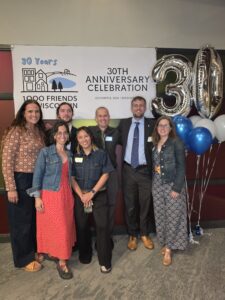
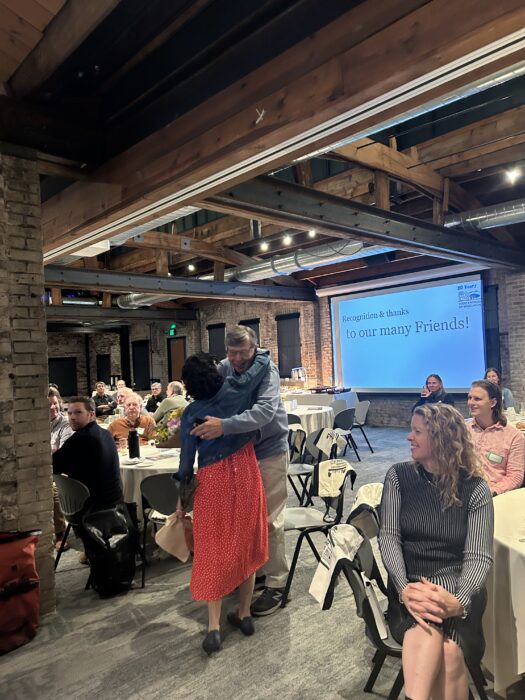
This autumn, we at 1000 Friends of Wisconsin celebrate our organization’s 30th anniversary. See below for highlights of our celebration. An exhaustive history of 1000 Friends has yet to be written, but our anniversary gives us time to ponder where the organization is, and where we would like it to be. But we must also look backward to see how far we have come!
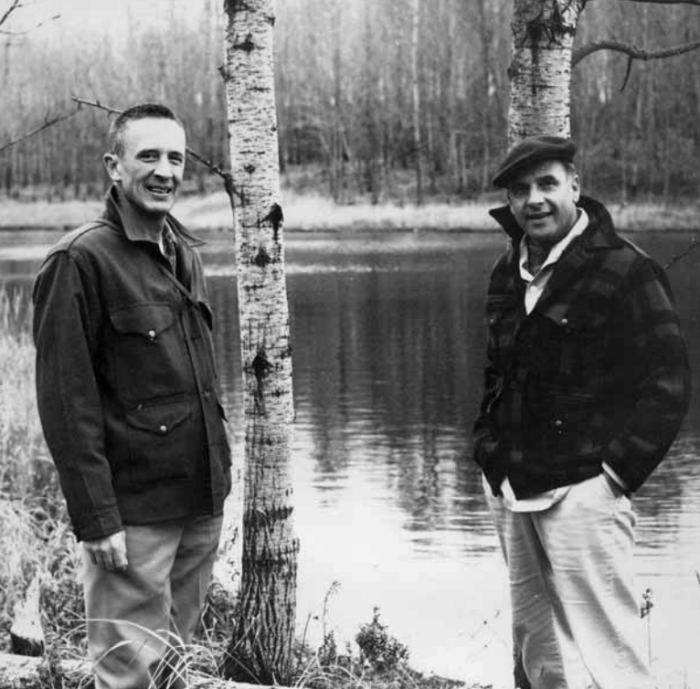
First Fundraising Letter, 1996: “We have an historic opportunity to impact land use policy in Wisconsin and to reverse the trend toward more sprawl. 1000 Friends of Wisconsin is determined not to let this opportunity slip by. Through research, legislative advocacy and public education, 1000 Friends is turning the tide in the fight against sprawl.”
Gaylord Nelson, Honorary Chair, 1000 Friends of Wisconsin
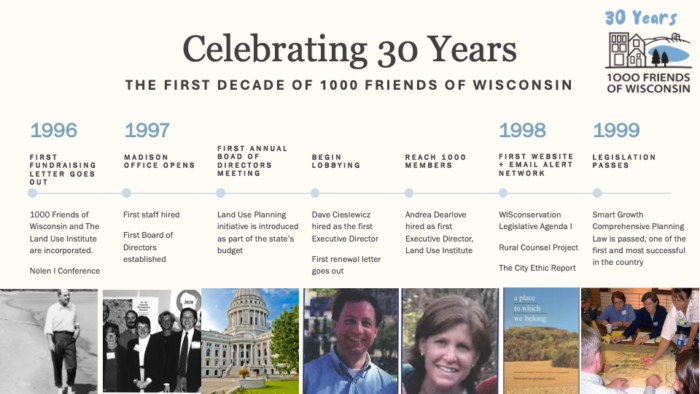
The First 10 Years
Motivated by concerns of unfettered urban sprawl and visionless development, Governor Tommy Thompson in 1995 created a “Strategic Growth Task Force” to address growing unease. The task force’s members included:
- Secretary of Revenue Mark Bugher (Chairman)
- UW-Stevens Point Professor Don Last
- Neenah Mayor Marigen Carpenter
- Conservationist Bud Jordahl
- UW-Madison Professor Brian Ohm
- Former Fitchburg Mayor Jeanie Sieling
- Merrimac Town Chairman Roger Shanks
- Dave Cieslewicz of The Nature Conservancy
- Real estate and construction industry representatives
The task force spent a year studying the issue and wrote a report in 1996 regarding land use. Most task force members desired to advocate for land use reform, and so Cieslewicz, Last, Sieling, and Ohm, among others, moved to found an organization modeled after 1000 Friends of Oregon whose focus would be statewide land use reform. Famed conservationist Aldo Leopold’s granddaughter, attorney Madelyn Leopold (and later board member), helped 1000 Friends incorporate. Thus, 1000 Friends of Wisconsin was born, the first nonprofit in Wisconsin whose focus was specifically responsible land use.
Our organization’s first board convened with former governor and US senator Gaylord Nelson to be an honorary chairman and solicited seed funds. Cieslewicz became the first executive director.
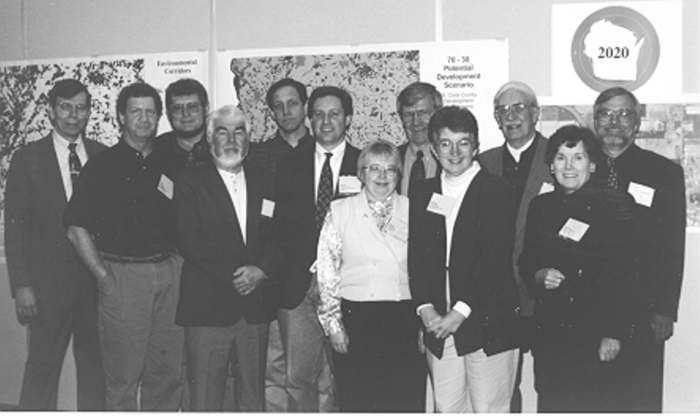
Founding Board in 1996
- Honorary Chairman: Gaylord Nelson, 1916-2005, Creator of Earth Day in 1970, US Senator (1963-1981), Wisconsin Governor (1959-1963), WI Conservation Hall of Fame
- Marigen Carpenter, Mayor of Fitchburg (1982-1998)
- Arlen Christenson, UW-Madison Professor Emeritus, WI Conservation Hall of Fame
- Dave Cieslewicz, Our First Executive Director, Mayor of Madison (2003-2011)
- Emily Earley, 1916-2011, Nature Conservancy Board Member, WI Conservation Hall of Fame
- Harold “Bud” Jordahl, 1926-2010, WI Conservation Hall of Fame
- Don Last, Our Founding Board President, UW-Stevens Point Professor Emeritus
- Jeanie Sieling, Mayor of Fitchburg (1985-1988), Dane County Planning Director (1996-2003)
- Roger Shanks, 1932-2004, Town of Merrimac Postmaster (1955-1981), Town of Merrimac Chairman, Sauk County Board Chairman (1992-1996)
- Brian Ohm, UW-Madison Professor Emeritus (and taught planning law to the author in graduate school c. 2016!)
In 1997, 1000 Friends had sufficient funds to lease a 500 square foot office in Madison and hire the first employee Nuria Hernández Mora, who would go on to become an assistant director and now resides in Spain as a senior researcher and environmental consultant. That year, 1000 Friends achieved 1,000 members and created the 501(c)(4) Land Use Institute headed by Andrea Dearlove and began lobbying for the Smart Growth Law which was introduced as part of the 1997-1999 biennial budget. In 2006, Cieslewicz recalled:
“First, we reached out to groups that had been thought of as traditional foes of the environmental movement, like the Realtors. Early on, we forged a solid working relationship with those groups with the understanding that we might disagree but we would always keep the lines of communication open. Second, we focused on the ‘demand side’ of sprawl. We didn’t just deal with the ‘supply side’ by trying to shut down land to development; we wanted to understand what motivated people to move out of central cities into sprawling subdivisions. We asked ourselves how cities could be made better so that the demand for sprawl was reduced.”
Watch: Dave Ciewlewicz, a Founder, the first Executive Director, and a long-time Board Member of 1000 Friends of Wisconsin.
The initial push was unsuccessful, but 1000 Friends kept advocating.
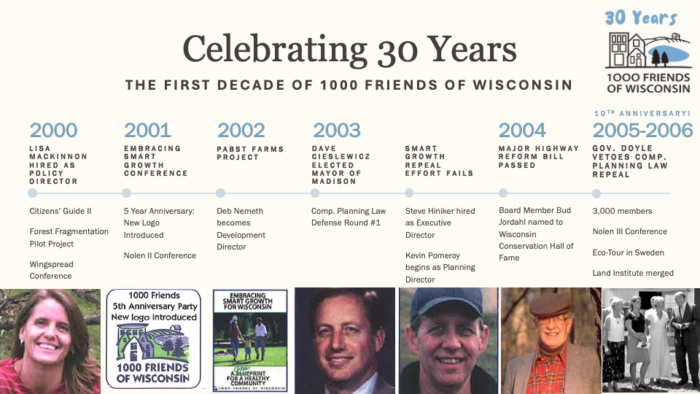
1000 Friends issued its WISconservation Legislative Agenda at the end of 1998. Finally, the Smart Growth Law, 1999 Assembly Bill 872, passed into law as 1999 Wisconsin Act 148 on May 24, 2000. The Smart Growth Law required zoning authorities to create comprehensive land use plans to plan for future growth. Pondering 1000 Friend’s success, Cieslewicz further recalled in 2006, “The Smart Growth Law that emerged has a heavy emphasis on good city-building and to this day its defenders include some strange bedfellows like the Sierra Club and the Realtors Association, the Alliance of Cities and the Towns Association. The Smart Growth Law forged a working relationship between groups that often clash on other issues.” Only a few years later in 2003, Cieslewicz would go on to become Madison’s “Mayor Dave” serving from 2003 until 2011 after his electoral defeat by the on and off again mayor, Paul Soglin.
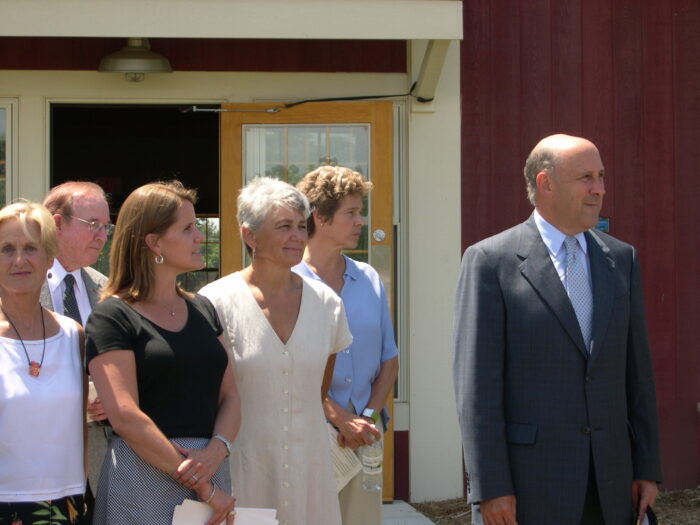
Steve Hiniker succeeded Cieslewicz as executive director upon the latter’s election, and the remaining founders did not rest on their laurels even after 1000 Friends fulfilled its original purpose. There were repeated legislative attempts to repeal the Smart Growth Law. Governor Jim Doyle vetoed a provision in 2005 Act 25, the 2005-2007 Biennial Budget Bill, which would have repealed it. There were also standalone repeal attempts in 2003 and 2005. Some legislators also tried, but failed, to carve out exceptions for local governments or otherwise weaken comprehensive land use planning in 2003 and 2006. Their efforts failed in part due to 1000 Friend’s advocacy and lobbying, right around when 1000 Friends achieved 3,000 members in 2006. The Smart Growth Law remains a bedrock in state policy. In the last legislative session, the legislature passed the “Truth in Planning Law” which seeks to ensure local zoning authorities properly follow their comprehensive plans (see our overview of the 2025-2026 Legislative Session here).
Continued Conservation Efforts and Nuances to Land Use Advocacy
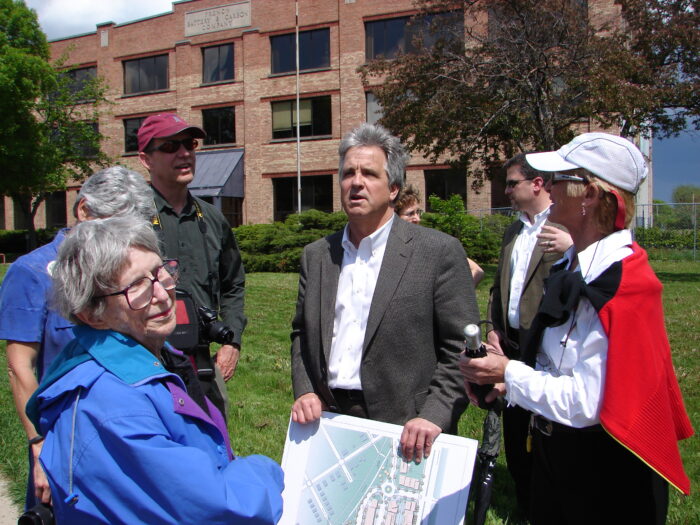
Even with the Smart Growth Law protected, 1000 Friends continued advocating for sustainability and land conservation. In 2006, the 501(c)(4) Land Use Institute was folded into the 501(c)(3) 1000 Friends nonprofit for simplicity of organization and finances. However, over time, the emphasis shifted more toward considering the balance of population land use density and how much space ought to be devoted to the storage and passage of private automobiles. Policies often divorced from each other in the United States, land use and transportation policy go hand in hand, and the sprawling nature of late 20th Century development in the United States put immense pressure on open space, both natural and agricultural.
Before Strong Towns entered the national scene, 1000 Friends of Wisconsin advocated for “creating a balanced transportation system” which does more than just subsidize single-occupant automobile travel. It further argued for the “Fix-it-First” approach to highway and road construction, rather than endlessly building more infrastructure which becomes increasingly unaffordable for our local, state, and federal governments. Along these lines, 1000 Friends in 2005 released its legislative briefing book, “Where Do We Go From Here?: Wisconsin Transportation at the Crossroads.” 1000 Friends pressured the Doyle Administration to increase transit system assistance and transportation aids for the elderly and disabled while trying to rein in highway spending.
1000 Friends opposed widening of Interstate 94 from the Zoo Interchange to 70th Street.
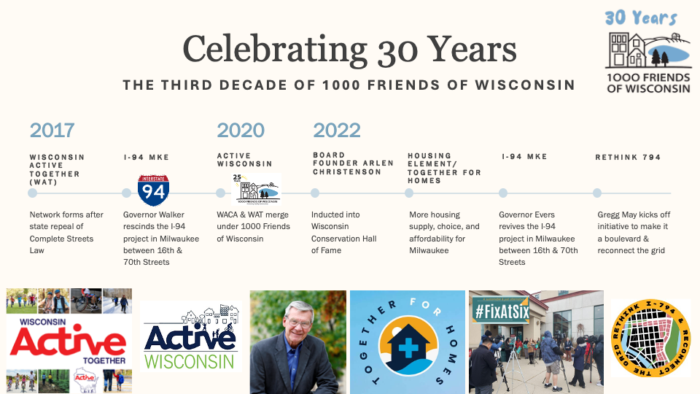
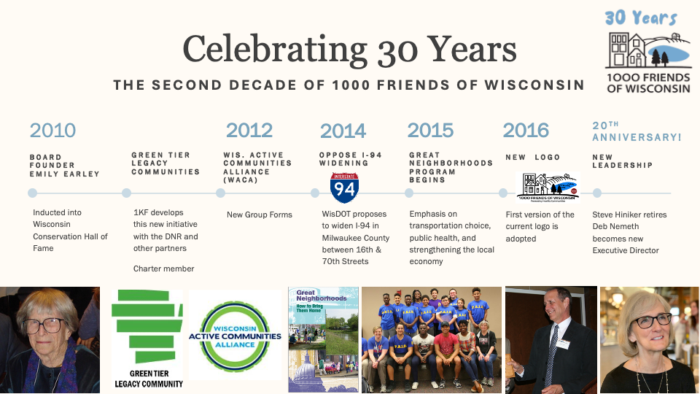
The “Fix-it-First” motto continued with the “Fix at Six” campaign to not widen a segment of I-94 in the City of Milwaukee, which WisDOT proposed in 2014. Governor Scott Walker rescinded the project in 2017, only for Governor Tony Evers to revive the project in 2020, with the Milwaukee County Board declining to oppose the erosion of its tax base in 2022 due to partisan politics and the City of Milwaukee. The City of Milwaukee took no action at all. Work began in October 2025, and that project is incurring cost overruns and years-long delays typical of highway mega-projects.
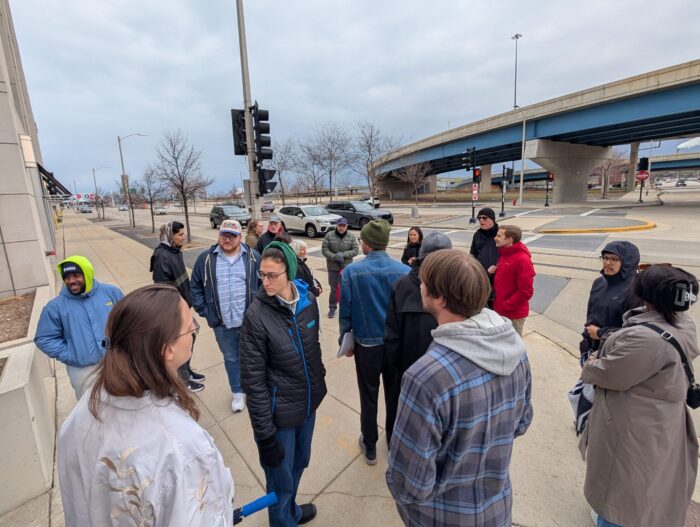
The Rethink 794 program, launched by 1000 Friend’s Gregg May in 2022, advocates for lowering a segment of elevated freeway in downtown Milwaukee into an at-grade boulevard, saving the taxpayers money in the long term by reconnecting downtown and the Historic Third Ward.
It would make the area more pleasant for residents and visitors, and create space for residential and commercial development over the most valuable land in Wisconsin, creating substantial property revenue to sustain municipal services. For years, Milwaukee Mayor Cavalier Johnson indicated he supported the boulevard option. Yet, the Mayor changed his tune fall of 2026, while members of the Milwaukee Common Council have voiced their support for the boulevard.
Part of deemphasizing automobile usage requires uplifting alternatives such as walking, biking, and transit. 1000 Friends has advocated for strong public transit systems and joined the lawsuit against the Wisconsin Department of Transportation, which alleged the I-94 freeway expansion caused a disparate impact on racial minorities in Milwaukee County. WisDOT settled for $X, which was spent by 2018.
In 2020, the Wisconsin Active Communities Alliance (est. 2012) and Wisconsin Active Together (est. 2017) merged under 1000 Friends into Active Wisconsin, in partnership with several statewide nonprofit and government organizations. In 2023, 1000 Friends launched its Community Transportation Academy, which teaches the issues to transportation advocates and empowers them to organize and positively impact their communities. Most recently, in 2026, 1000 Friends launched Better Streets Madison to challenge WisDOT on its proposed design alternatives for the reconstruction of Stoughton Road.
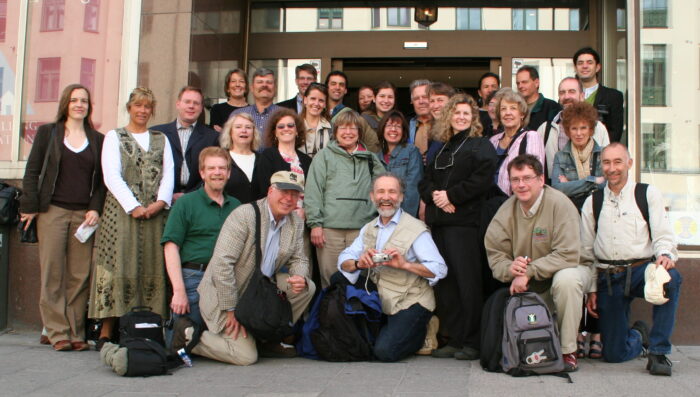
On the land use side of things, 1000 Friends remained active even while receiving comparatively less attention. Staff went on an Eco-Tour in Sweden to learn how that Nordic country was implementing sustainable principles.
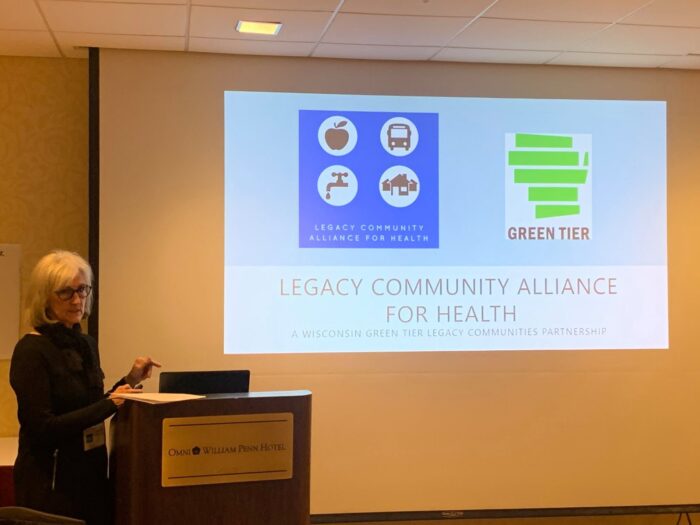
In 2010, 1000 Friends of Wisconsin was a charter member of the Wisconsin Department of Natural Resource’s Green Tier Legacy Community program, an initiative by which communities and organizations may voluntarily “align their business objectives with environmental performance by providing a voluntary platform for collaboration with the [WDNR].” At the time of writing, there are 44 local governmental members.
A significant initiative which began in 2015 was the Great Neighborhoods Program, which emphasized choice in transportation options, public health, and strengthening the local economy in Madison. Steve Hiniker would retire as executive director in 2016 and Deborah “Deb” Nemeth succeeded him. Nemeth had been with 1000 Friends since 2002 as development director.
2022 saw the launch of Together for Homes in Milwaukee as the City of Milwaukee worked to revise its zoning code to allow for higher density in the Growing MKE initiative to induce a population increase to one million residents. Mayor Cavalier Johnson’s effort has experienced headwinds as wealthy East Side NIMBYs aligned with low-income neighborhoods (unnecessarily) afraid of displacement. The work of Together for Homes remains ongoing as the City of Milwaukee works on its rebranded and watered down Housing Element.
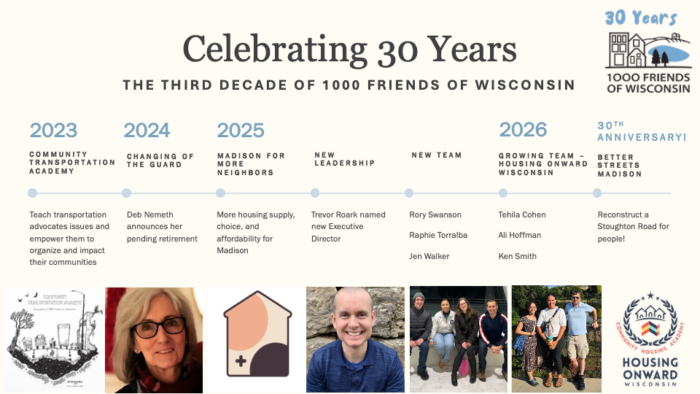
Madison’s counterpart became Madison for More Neighbors in 2025. Though the City of Madison has been far more successful in reworking its land use regulations to enable more construction which has struggled to keep up with the demands of an attractive community and growing biotechnology and information technology sectors in the area.
Finally, in 2026, 1000 launched Housing Onward Wisconsin to advocate for changes in state law which will enable more housing, more affordable housing, and more housing types.
Today’s Programs in Historical Context
In 2024, Deb Nemeth expressed her intent to step down, and Trevor Roark succeeded her in 2025. In short order, the remaining staff decided to pass on their batons, and there was an entirely new team of four. Finally, in 2026, a grant enabled the hiring of three more staff to focus on statewide land use reform.
1000 Friends of Wisconsin’s active programs currently fall under the following umbrellas:
- Transportation
- Rethink 794 (Milwaukee)
- Housing
- Together for Homes (Milwaukee)
While these programs do not explicitly focus on conservation, they are premised upon the wise use of land, and 1000 Friends has never lost sight of its roots in conservation and wise land use. Preservation of open space and a proper land ethic which, according to Aldo Leopold, “does affirm [nature’s] right to continued existence, and, at least in spots, their continued existence in a natural state.” Walkable neighborhoods where most daily needs are accessible within a one-mile radius and environments built for people and not automobiles go hand in hand with Leopold’s land ethic and consume far less land.
The University of Wisconsin historian, Frederick Jackson Turner, declared the American frontier closed in 1893, but we arguably maintain a frontier mentality of inexhaustible land in 2026. Local governments struggle to maintain their automobile infrastructure while the state and federal governments incentivize further system expansion. Postwar governmental regulations have stifled the type of traditional built environments many of us travel to the Old World, or Disney World, to experience. They were once commonplace across urban and rural Wisconsin and is now out of living memory for most. Presently, there is insufficient housing for us younger generations to reasonably afford. That always hits low-income people harder, especially because wages have not kept pace with productivity gains or inflation over the last several decades.
Solutions to our land use and transportation challenges have not yet permeated broadly enough. And reform-minded local governments face stiff resistance from NIMBYs and those in favor of the status quo. 1000 Friends of Wisconsin has had its successes and failures, but its raison d’être continues.
As founding board president and now UW-Stevens Point professor emeritus, Don Last wrote in 2006, something which remains relevant today:
“It is evidence to me today that the resolve of the leaders and members of 1000 Friends of Wisconsin has not diminished since I wrote the following words also nearly a decade ago: ‘Is the future of our beloved state bleak? The answer is absolutely not if we have anything to say or do about it! We are the chief advocacy group for a sustainable future for Wisconsin. We are raising the alarm about the consequences of continued ‘visionless’ development. We can move forward with our WisConservation action agenda. This agenda is intended to create better places to live, to preserve our cultural heritage, to improve land use planning, and to result in better decisions on transportation and public water and sewer systems. This action agenda is reasonable, rational, and achievable – with a little help from our friends.’
“Making ‘friends’ was both a challenge and a joy for the original steering committee and for the founding board. Through the years, the group’s vision has been pushed forward in countless ways by caring individuals and like-minded groups. It is very gratifying to note that, since its 1996 startup, each and every year has been a good year for 1000 Friends of Wisconsin. Unquestionably, the implementation efforts of the organization have had profound effects on future uses of the land and water resources of our state.
“While the need for a statewide land use advocacy group was clear in 1996, it is equally evident there is still a great need for the valuable work of the first and best champion of wise land use – 1000 Friends of Wisconsin.
“Happy Birthday and long life to you!”