
By Ken Smith, Housing Policy Director at Housing Onward Wisconsin
What are Community Land Trusts anyway?
The community land trust is a model that can help sustain affordability for lower and potentially middle-income individuals, with the further potential of mitigating the excesses of land speculation.
A land trust is a private nonprofit entity that places land in a trust outside of individual private or public ownership. Conservation land trusts have existed since at least 1891 in Massachusetts, but have grown substantially in number and acreage in the United States since the 1980s to preserve wild areas and natural resources without public land ownership. The Nature Conservancy is a notable example.
Meanwhile, community land trusts (CLTs) acquire land with the goal of preserving affordability for lower-income individuals. In the anglosphere, Scotland had a CLT in 1908, but the first in the US for a low-income population wasn’t until 1968 in rural Georgia.
CLTs maintain private, nonprofit ownership of the land beneath a home, with the homeowner only owning the structure on the land, contracting into a ground lease with the CLT. The CLT is another way to mitigate the appreciation of the home’s value while the homeowner pays a modest rent to the CLT for maintenance purposes. CLT homeowners are typically selected based on certain lower-income requirements relative to a percentage of the county’s area median income (AMI) as calculated by the U.S. Department of Housing and Urban Development (HUD).
CLTs can help facilitate mixed-income neighborhoods, where individuals are not priced out of the places where they work and/or where they grew up. CLTs may be especially effective in rapidly growing areas with insufficient housing supply across various price points. However, CLTs are often made more difficult by the high costs of acquiring properties.
Some proponents see CLTs as a way to reform the distribution of land without direct redistribution or communist-style collectivization, while also seeking to protect lower-income individuals from the “unearned increment” of land speculation by which landowners gain value on their land simply by holding onto said land without making any improvements. More simply, many CLT proponents seek to return housing as a place to live, rather than an investment commodity. Further, CLTs seek to separate homeownership from landownership through shared equity, thereby allowing community gains for those with a direct stake in the CLT to lock in permanent affordability at the expense of individual wealth building.
CLTs also seek to have their local governments levy property taxes on the smaller resale rate, rather than the market appraisal rate. This keeps property taxes lower and more affordable for the owner, and more commensurate with the lower income, but reduces the contribution to the local tax levy and therefore reduces funding to local services like schools, libraries, and police and fire departments. Without a sufficient influx of housing supply relative to the population demand, there could be a greater disconnect over time between market-rate homes and CLT homes, all else being equal.
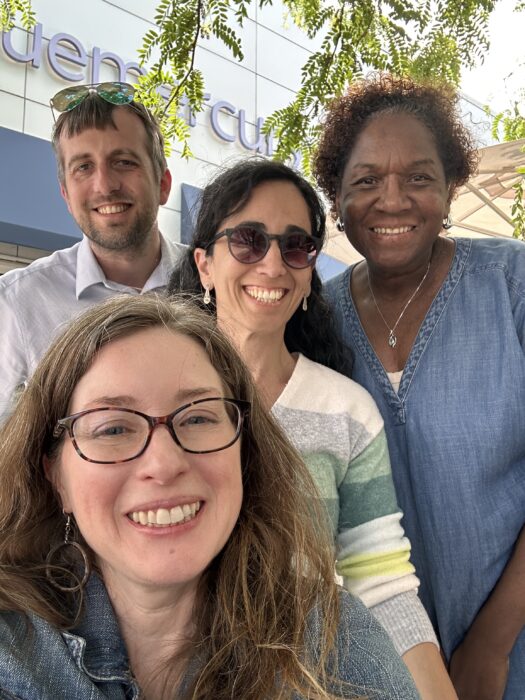
To see how these concepts are playing out on the ground, our team has been closely tracking local policy discussions. This April, several of us attended two housing forums in Milwaukee to hear how researchers, local advocacy groups, and municipal leaders plan to implement equity strategies.
Greater Notoriety of CLTs
It appears the number and awareness of CLTs are growing amidst the current housing crisis. Wisconsin has CLTs in the following counties: Brown, Crawford, Dane, Door, La Crosse County, Milwaukee, Monroe, and Vernon. Another organization is working toward CLT ownership in Ashland and Bayfield Counties.
A strong proponent of CLTs is Professor Kirk Harris of the University of Wisconsin – Milwaukee’s Center for Equity Practice and Planning Justice, a research center within the university’s School of Architecture and Urban Planning (SARUP) – note: 1000 Friends sponsors the Center.
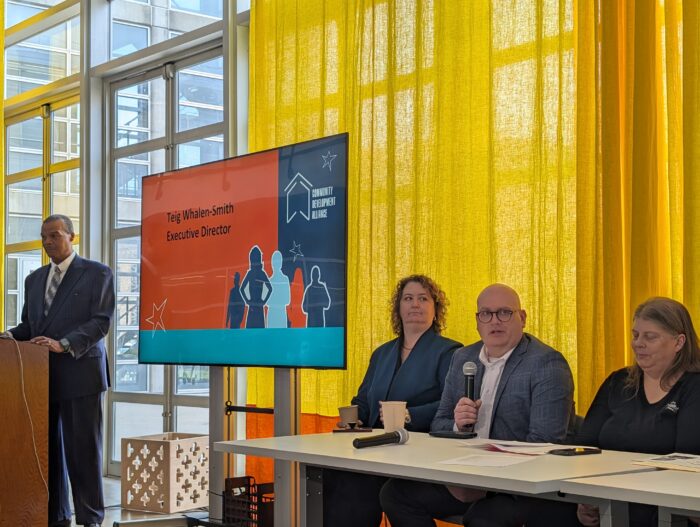
On April 8, Professor Harris hosted a symposium on “Housing Justice for Milwaukee: Community Land Trusts, Equity Strategies, and the Path to a Justice-Oriented City.” The symposium’s speakers included Erika Sanders of the Metropolitan Milwaukee Fair Housing Council (MMFHC), Teig Whaley-Smith of the Community Development Alliance (CDA), Beth Van Gorp of Milwaukee Habitat for Humanity, Sam Leichtling of the City of Milwaukee Department of City Development (DCD), Ian Bautista of the Greater Milwaukee Foundation, Lamont Davis of the Milwaukee Community Land Trust, and Latasha Henley, an owner of a land trust property. Trevor, Tehila, and I attended, among many others. This ensemble of Milwaukee housing leaders discussed their various approaches to the housing crisis with an overall notable emphasis on community land trusts (CLTs).
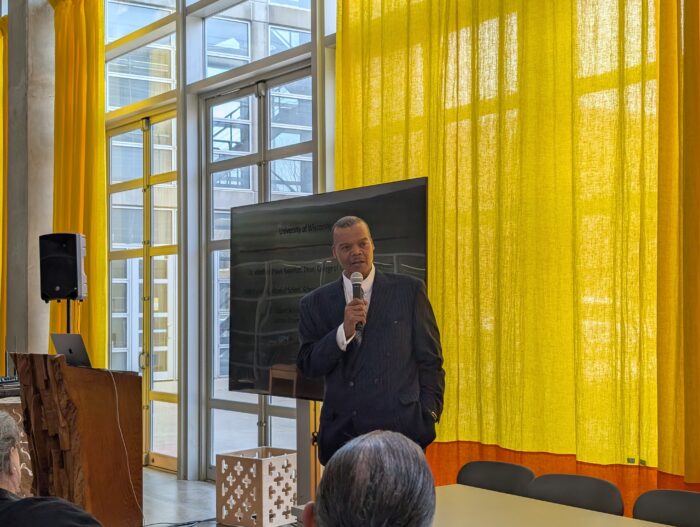
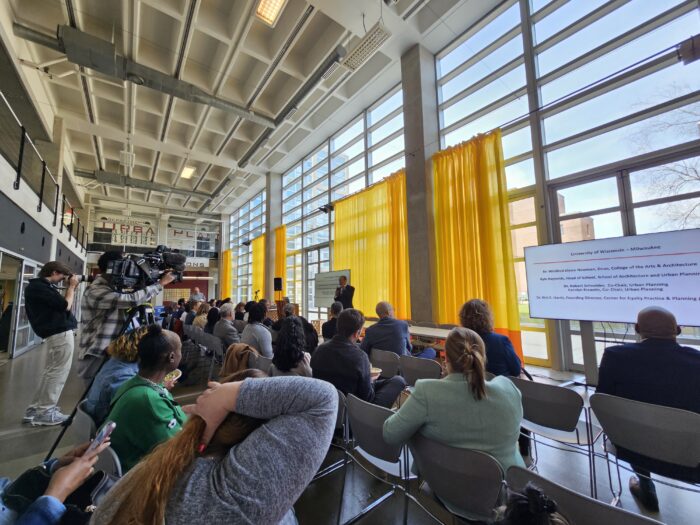
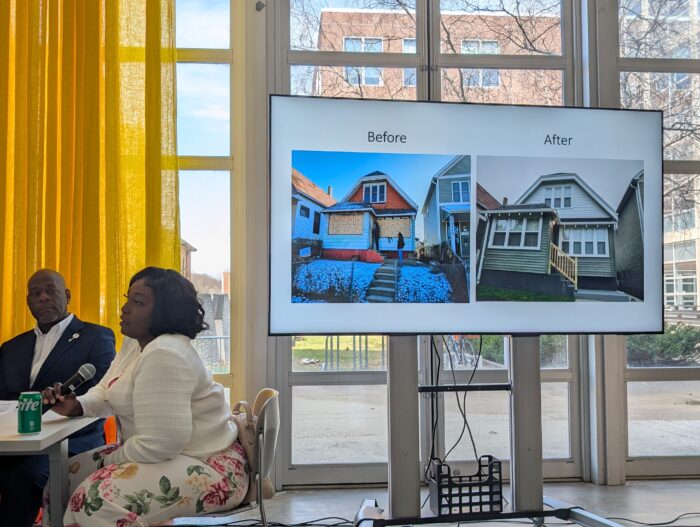
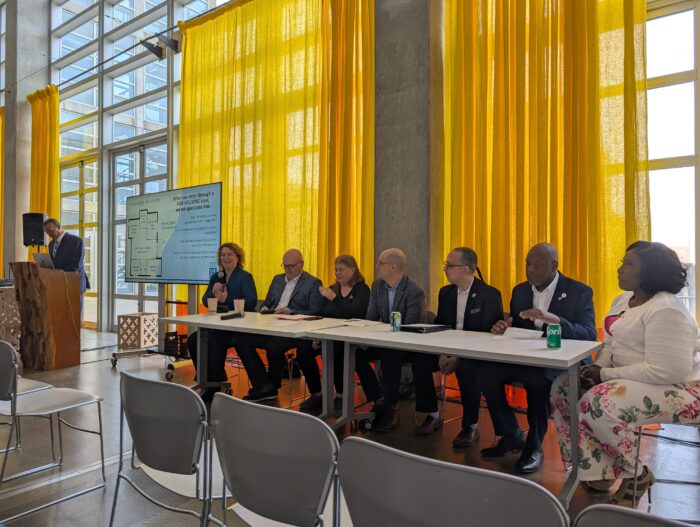
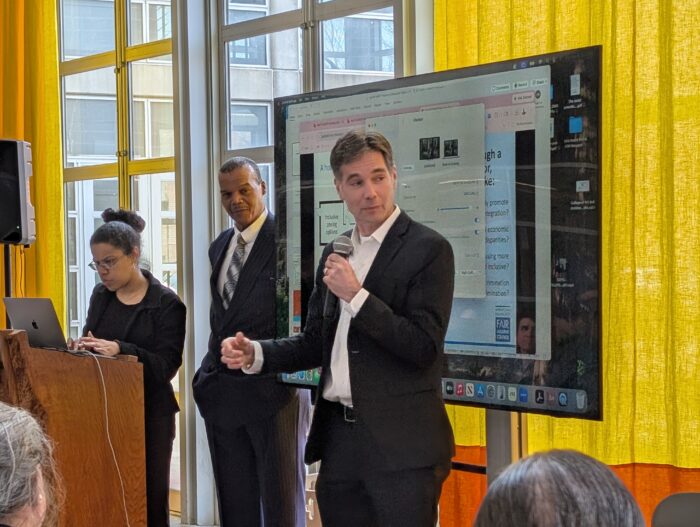
While not speaking specifically to CLTs, Milwaukee DCD Deputy Commissioner Leichtling emphasized how Mayor Cavalier Johnson earlier this year declared 2026 the Year of Housing. The Johnson Administration supports pathways to homeownership, building new styles of housing, and expanding partnerships to slow the rise of rent costs and the cost of housing while ensuring safe homes for all.
Civic Engagement Senior Director Bautista articulated how private philanthropy and funders like the Greater Milwaukee Foundation can be a possible funding source for housing organizations like Habitat for Humanity or the CDA. Philanthropy can also collaborate, endorse, and convene partners to help make things happen in the housing space and elsewhere.
President and CEO Sanders described fair housing as the “entrance” to the “dwelling” of affordable housing development, with rooms including community land trusts, access to credit, inclusive zoning options, housing rehabilitation, and more.
CDA Executive Director Whaley-Smith discussed the threat of displacement from development and further discussed displacement by abandonment which he defined as “The transfer of a property over time to absentee landlords that deplete a property of rent without making investments, eventually leading to abandonment of property and displacement of the last family that lived in the home.” Whaley-Smith referred to the pervasive problem of unethical absentee landlords, often referred to as “slumlords” who profit-maximize by charging market-rate rents while not maintaining their properties, leaving tenants living in horrid and unsafe conditions.
Habitat for Humanity is well-known for constructing quality, modest homes and selling them to lower-income owners below market prices with donations of money and volunteer labor, while also having future owners provide their own “sweat equity.” Advocacy and Government Relations Director Van Gorp discussed that allowing homeowners to build generational wealth through homeownership has been a bedrock of Habitat’s mission. However, with home prices rapidly outpacing the ability of low-income and increasingly middle-income families to pay, Habitat Milwaukee has begun instituting deed restrictions to limit the ability of property values to appreciate by slowing their rise, with the goal of ensuring long-term affordability. Other affordability measures Habitat Milwaukee is considering include ground leases via CLTs.
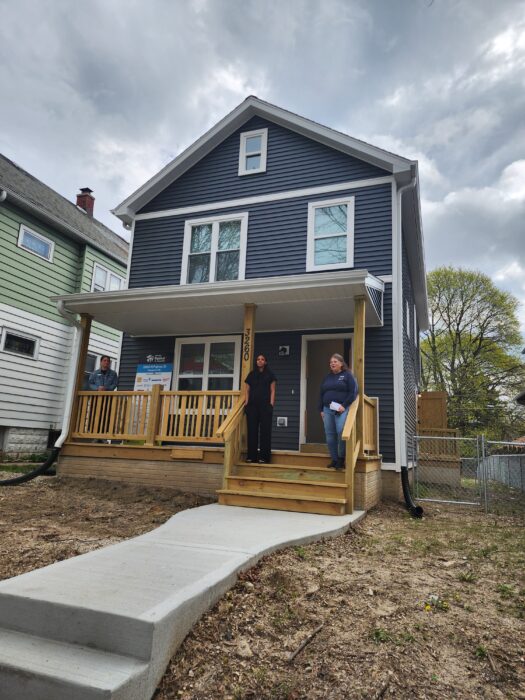
Executive Director Davis explained how the Milwaukee CLT operates. Homeowners take possession of the house and related improvements while the CLT owns the land for stewardship and monitoring, granting occupancy of the land to the homeowner on a 99-year renewable ground lease with controlled resale. Davis argued that the CLT model is “built for permanent affordability.” CLT homeowner Henley shared her experience with the Milwaukee Community Land Trust. She was initially skeptical but found the CLT arrangement beneficial for her to be a homeowner.
Rethinking Sustainability: Sustaining Housing
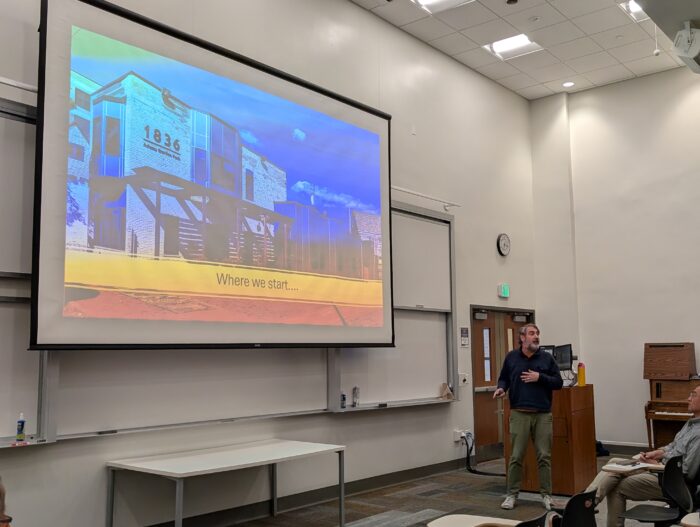
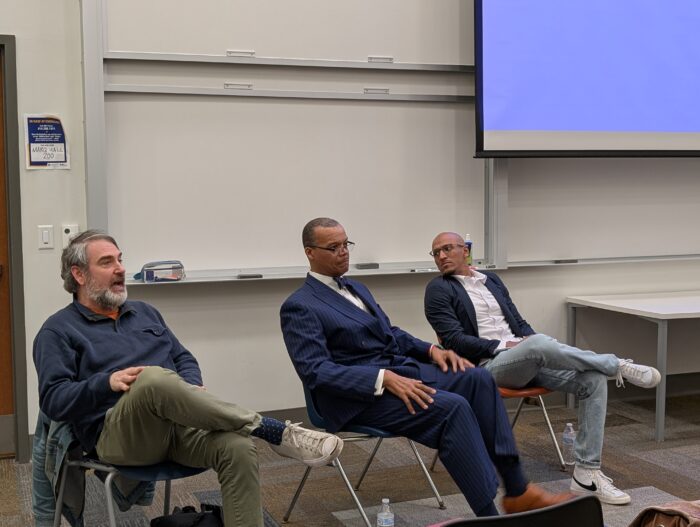
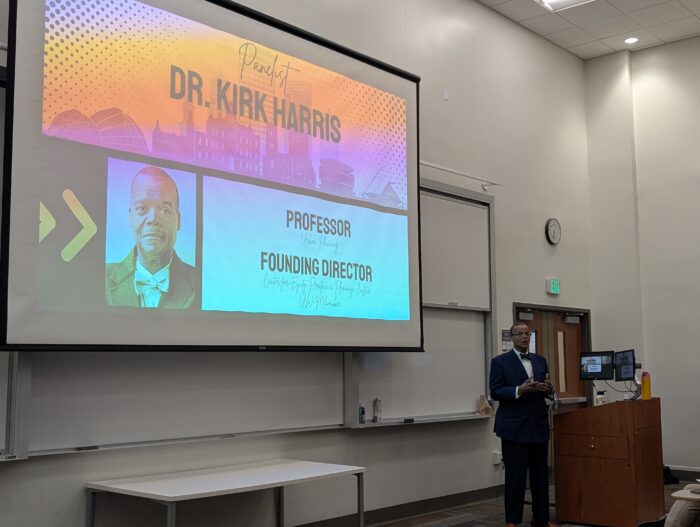
A couple of weeks later, on April 22, Tehila and I revisited the CLT topic at Marquette University. CLTs may be a means to sustain housing in lower-income communities while mitigating slumlords. Community Life Manager Michael Pagán of Thrive for Life officiated between Milwaukee School of Engineering (MSOE) Professor of History Michael Carriere and UWM’s Professor Harris.
Harris reiterated the case for CLTs as a solution to scaling access to affordable housing and mitigating land speculation, and for disinvested communities to build wealth. He challenged the orthodoxy of the status quo, calling it “insanity for doing the same thing ad nauseam.”
Carriere in his presentation, pondered what communities ought to do with abandoned properties resulting from disinvestment, deindustrialization, and abandonment. He further described how the 2008 Financial Crisis, which harmed many Americans, especially harmed low-income minorities whose properties were often bought by out-of-state landlords. Many such landlords turned out to be slumlords who have done little or nothing to maintain the properties to maximize their revenue, renting the units out at market rate even while leaving tenants in at times dangerous and inhumane situations.
The CLT may be a model to contribute toward mitigating this problem in addition to creating permanent affordability.
Please also see:
- My April Update on how housing the poor can be very profitable, especially when profit-maximizing at the expense of decency and ethics.
- How Milwaukee-based Common Ground and Tenants United organizations to partner with Milwaukee City Attorney Evan Goyke to challenge slumlords for the City to take receivership, or temporary possession, of the properties due to their owner’s dereliction. Milwaukee Public Radio channel WUWM 89.7 has a “How to Evict Your Landlord” mini-series detailing this local effort and WUWM’s reporting achieved national coverage on National Public Radio.
Suggested Reading on Conservation and Community Land Trusts
- Campbell, Marcia Canton and Danielle A. Salus. “Community and conservation land trusts as unlikely partners? The case of Troy Gardens, Madison, Wisconsin.” Land Use Policy 20, 2003.
- Curtin, Julie Farrell and Lance Bocarsly. “CLTs: A Growing Trend in Affordable Home Ownership.” Journal of Affordable Housing & Community Development Law, Vol. 17, No. 4, Summer 2008.
- Daniels, Thomas L. Holding Our Ground: Protecting America’s Farms and Farmland. Washington DC: Island Press, 1997.
- Davis, John Emmeus. “Reallocating Equity: A Land Trust Model of Land Reform” (1984). The Community Land Trust Reader. Ed. by John Emmeus Davis. Cambridge, MA: Lincoln Institute of Land Policy, 2010.
- Davis, John Emmeus, Ed. The Community Land Trust Reader. Cambridge, MA: Lincoln Instute of Land Policy, 2010.
- Gerber, Jean-David. “The difficulty of integrating land trusts in land use planning.” Landscape and Urban Planning, Vol. 104, 2012.
- Moore, Tom and Kim McKee. “Empowering Local Communities? An International Review of Community Land Trusts.” Housing Studies Vol. 27, No. 2, March 2012.

Do you want to be part of future housing conversations?