
By Ken Smith

Our newly inaugurated housing team at 1000 Friends of Wisconsin has begun its work, and housing is a major issue on the minds of people across Wisconsin and the nation.
This year marks the hundredth anniversary of the landmark US Supreme Court Case, Euclid v. Ambler Realty Co., which deemed land use zoning constitutional. Euclid has greatly impacted where housing can legally be built, who lives where, and how we interact with our environment. Governor Tony Evers in his State of the State address on February 18, declared 2026 the “Year of the Neighbor.” Further, Milwaukee Mayor Cavalier Johnson has declared this year to be the “Year of Housing.” With housing as an integral element of land use, there is no better time for 1000 Friends of Wisconsin to expand our scope statewide with affordable and attainable housing advocacy!
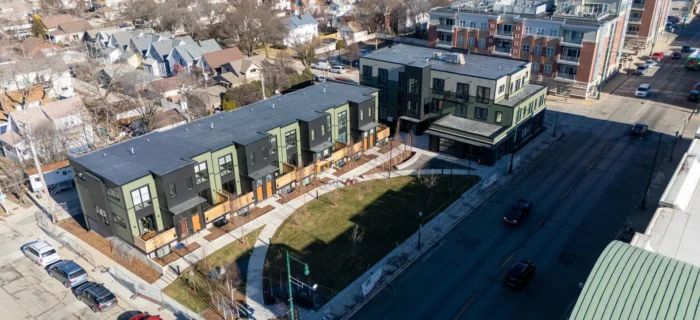
On February 19, Field Organizer Tehila Cohen and I attended an event discussing the challenges of adding Missing Middle Housing, specific to the Union Green development in the City of West Allis at 6400 W. Greenfield Avenue. The philosophy of Architect Joe Galbraith of Galbraith Carnahan Architects and Developer Jeff Hook of JJH3group was, “Rather than maximizing density, the project demonstrates how modest-scale housing can be inserted into an established urban context to reinforce walkability and neighborhood continuity.” Galbraith and Hook found the building code the most difficult to navigate, which added time and cost to the project. They argued that missing middle housing does not fit neatly into either the residential or commercial building codes and may warrant a separate “missing middle building code”, or at the very least, greater flexibility. On the financial side, Hook found greater financial risk for their project relative to a standard apartment or single-family home development.
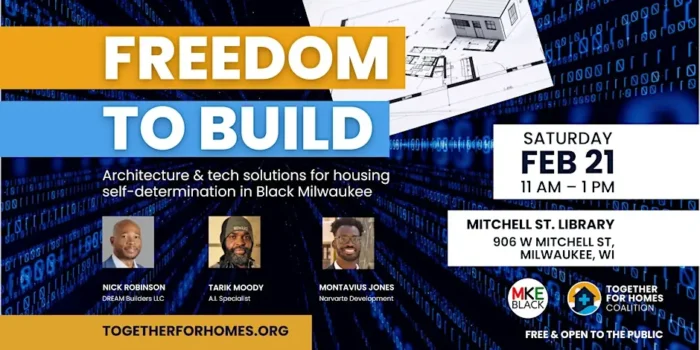
On February 21, Together for Homes Coalition (a 1000 Friends of Wisconsin campaign) and MKE Black hosted the Freedom to Build event at the Mitchell Street Branch of the Milwaukee Public Library. There, I learned a bit about architecture and how applied tech can make zoning requirements easier to understand. Montavius Jones of Navarte Development emceed the event, while Architect Nick Robinson of Dream Builders gave a high-level overview of African and African-American architecture throughout history. Artificial Intelligence specialist Tarik Moody finished the event, presenting on an AI application that could prove beneficial for developers in illustrating zoning requirements for specific parcels, making municipal requirements more transparent and easier to understand. Through AI-prompting, the tool could also AI-generate homes on vacant lots to help envision what a new home might look like in the area. It was an interesting and solution-driven use of tech.
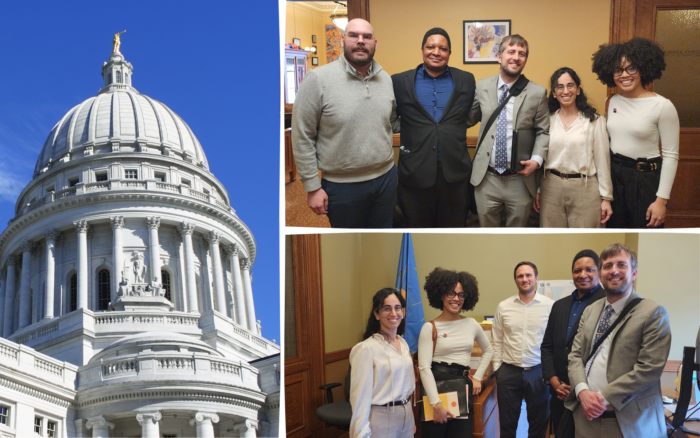
On February 24, Tehila and I joined Dream.Org partners Jarrett English and Naomi Garcia-Hector to speak with Wisconsin legislative staff from both chambers and parties. The good news is that elected officials and their staff are well aware of national and statewide housing challenges related to affordability and supply. It was a great opportunity for our team to get an update on the status of housing legislation for the 2025-2026 Legislative Session, as well as what may occur in the next legislative session as this one draws to a close. Once the legislative session has concluded, I will follow up with a summary of housing-related legislation and how it may affect the development of housing in our great state.
Finally, on February 28 (to cap off Black History Month), I attended the Mapping Racism and Resistance event at the Wisconsin Black Historical Society in Milwaukee. The effort is operated by the University of Wisconsin – Milwaukee’s Professors Anne Bonds and Derek Handley in an attempt to chronicle every racially restrictive covenant in Milwaukee County from 1910 to 1960. Once complete, the project will allow researchers to analyze and visualize patterns and themes of both racism and resistance to racism. And you can already view more than 32,500 mapped records!
What are racially restrictive covenants? In short, they were discriminatory measures in property deeds and subdivision plats, among other legal instruments, which primarily prohibited Black Americans, but also other marginalized groups like Jews and foreigners, from buying or residing on property. This was one of many legal mechanisms used to enforce discrimination in the past. The Mapping Racism and Resistance effort demonstrates how Americans have historically failed to live up to the core values of the Declaration of Independence, Preamble to the Constitution, and Bill of Rights. However, the effort also shows the progress our society has made, while also considering the ways we are still divided by race, class, and ideology in the places we live today.